Divekick (PC) Review: Kick It
 Can a fighting game only have two buttons? It doesn’t seem to be a necessary question. Any game can use any control scheme the developer chooses so long as it works.
Don’t tell that to some vocal members of the fighting game community who consider Divekick to be a joke. How can a fighting game only have two buttons, no combos and only one-hit kills via jump kicks? It clearly doesn’t belong in the same category as multi-button, combo-laden games like the Street Fighters, Tekkens, Soul Calibers and Mortal Kombats of the world.
So does having only two buttons make Divekick a sick joke or is it so well put together that it actually pulls off the adrenaline rush of a fight game with a simple facade?
When I say that Divekick has only two buttons, I mean that in the most literal sense possible. You have two buttons: Dive (jump) and Kick. These are the buttons used for combat, menu navigation, character and option selection. Apart from the pause button (Esc), you will use only two buttons. It’s a massive pain in the arse in the menus. Dive to go left, kick to right and both to select works but holding dive to go back is ridiculous. Couldn’t I use any of the other dozens of keys on my keyboard for that?
In combat, however, two buttons works perfectly. The controls are crisp and responsive. Diving and kicking happens pretty instantaneously which allows the necessary reactions to your opponents to come down to your reaction time. And divekicking an opponent into oblivion can come down to those fractions of a second.
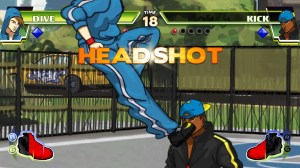 And just because the game comes down to diving and kicking doesn’t mean that it’s a simple game. Sure, you win by divekicking your opponent but each of the game’s 13 characters play different from each other. Despite not being hypertechinical in terms of controls, each character has different jumping height and speeds and kicking angle and speeds. As such, different fighters require different strategies when you face them. Fighting against a character with a fast, narrow angle kick is a very different experience than fighting a character who has a shallower angle on their kick, The setup results in a fair amount of depth in the combat itself even if the game doesn’t have scads of characters or a lengthy story mode.
As a result of the simple controls and one-hit kills, Divekick matches tend to devolve into high-speed games of chess. Feinting kicks, using special abilities (each character has a unique ground and air special ability), activating the kick meter (which increases your characters jumping and kicking speed) and backpedalling are all necessary tactics to keep your opponent on their toes. You have to balance getting into position for a kill without putting yourself in too much danger while baiting your opponent into making a mistake.
The mental game is probably the most important part of playing online and local multiplayer. Learning your opponent is probably more important than knowing your own character. As such, even the AI displays a degree of learning and adapting to your strategy.
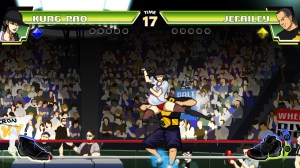 The gameplay isn’t perfect. There are some issues with the hitboxes on some characters when what appears to be a kill iscalled misses and kicks to the chest and shoulders are scored as headshots (which provide a big advantage in the next round of a best of nine match). The final boss of the game tends to be painfully cheap thanks to a teleporting jump ability that makes beating the story mode more luck than skill.
While I don’t have many issues with the the actual combat, the presentation of the game has been getting a lot of attention from critics. That’s because the game has been describe as a sort of in-joke about the fighting game community. Characters are named after various important figures in the FGC while their look are based on characters from other fighting games. Though, if fight game references aren’t your thing, characters Dive and Kick have a backstory that’s a parody of Fresh Prince of Bel Air.
The visuals and sound aren’t anything special. The graphics have an almost handdrawn quality about them. I see the term “flash game” thrown around when describing the graphics which doesn’t seem wrong. The visuals are functional and don’t look terrible which is good enough for me. The sound is fairly forgettable. Apart from the faux Japanese accent of the announcer and the occasionally funny quip from a character, there isn’t much sound of note in the game. It probably shouldn’t be a deal breaker in a fighting game but some people have odd hang-ups.
Conclusion
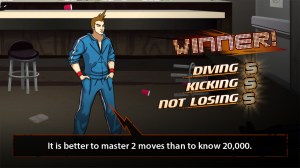 Divekick is really a game that is what you make of it. You can immediately be off-put by the simple control scheme and underwhelming visuals when compared to the big fighting games or you could take this game for the part-parody, part-love letter to the fighting game community that it’s trying to be.
At the end of the day, it’s a simple but well-executed indie fighting game that only costs $10. You get better value on PlayStation because your PS3 version also has cross-play with your Vita. The problem is that $10 doesn’t get much length of play. Apart from playing with your friends, there isn’t much to keep you coming back after you beat the story mode twice (maybe you’ll get more out of it) and get a few online matches in. It just doesn’t have that hook that keeps you coming back to the great fighting games.
Given the lack of replayability and the massive in-jokiness to the FGC, it’s not an across the board recommendation. Fighting game fans, especially hardcore members of the FGC who know the personalities and the memes, will find a lot to love here. Everyone else will find it to be a nice time filler but not a must-own title.
Rating: 6.5/10
Divekick was reviewed on PC but is also available for PlayStation 3 and PlayStation Vita. Your impressions of the game may differ based on system specs, the platform played on and whether you believe that a fighting game can actually have only two buttons.
Share this:


Posted on September 6, 2013, in Game Reviews and tagged Divekick, Iron Galaxy Studios, One True Game Studios, PC, Review. Bookmark the permalink. Leave a comment.


 et geekera
Leave a comment
Comments 0