Antichamber Review: You Just Wrinkled My Brain
 It’s been a while since I’ve seen the gaming press soil themselves in excitement over an indie release but that’s exactly what happened in the run up to the release of Antichamber.
The game has been described as Escher-like, in reference to the famous Dutch “impossible reality” painter M.C. Escher. You might know his drawing “Relativity” which shows people climbing stairs with no regards for the laws of physics at all. And that seems to be where Alexander Bruce got his inspiration for Antichamber.
The goal of Antichamber is to escape from the titular Antichamber by navigating the maze that lies ahead of you. However, it’s not nearly as simple as it sounds. The normal laws of physics and video games do not apply here. This isn’t a Valve puzzle game designed to show off a physics engine. This is one man who sets out to challenge everything you take for granted in video games.
This is demonstrated right off the bat in the game. Upon entering the Antichamber puzzle/maze, you’re presented with a command to jump a chasm. In most games, you would succeed in making that jump. Instead, you fall to the bottom of the pit and are given a message that failure doesn’t mean failing to proceed.
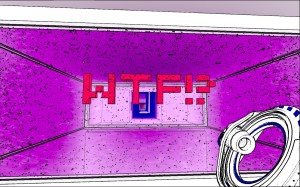 And that’s how the whole game progresses. It’s not that you fail repeatedly and fall into a series of pits, though it happens often enough. You have to check your expectations at the door. Not everything is as straight forward as it seems and you need to be willing to approach puzzles from multiple points of view (literally and figuratively) to get the job done.
Sometimes, the game gives you vague hints as to how to proceed and it’s worth following them (unless the game actively tries to trick you). One such time is when you see a sign that says to look up. I didn’t and found out on my next go at that puzzle that I should follow the game’s advice there.
The graphics are fairly unique. It’s functional given what they’re trying to do but they won’t win any awards for realism. The graphics in Antichamber are really more of a recreation of an acid trip than Portal’s attempt at creating a more realistic environment. Considering that Antichamber throws away the laws of physics, it’s only appropriate that they have trippy graphics too.
The audio doesn’t help you not feel as though you’re having an acid trip. The music is subtle and sound effects understated. However, there are some odd sound effects thrown in. I was not expecting the seaside sounds of seagulls and crashing waves while walking through a dark tunnel at the bottom of a chasm. This game actively tries to screw with your head.
Conclusion
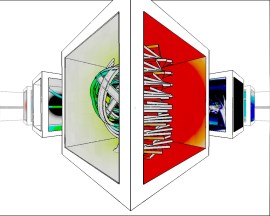 Just because it’s a puzzle game does not mean that Antichamber is Portal. They are two very different games. Portal is about dark humour and physics and science (you monster). Antichamber, on the other hand, is about none of that. Antichamber is about surrealism and a place where science and physics as we know it don’t apply.
That doesn’t mean that Antichamber is a bad game. It’s just very, very different. That’s what makes it hard to review. Even as a puzzle game fan, I found Antichamber difficult to wrap my head around. I guess whether you will like it or not comes down to if you’re willing to have everything you thought you knew about puzzle games challenged.
At the very least, though, we have an early frontrunner for puzzle and indie game of the year.
RATING: 8.5/10
Share this:


Posted on February 14, 2013, in Game Reviews and tagged Alexander Bruce, Antichamber, Indie, PC, Review. Bookmark the permalink. Leave a comment.


 et geekera
Leave a comment
Comments 0